

Recent data shows the average American homeowner spends over $8,800 per year on maintenance and repairs, with total hidden homeownership costs exceeding $21,000 annually according to Bankrate’s 2025 Hidden Costs of Homeownership Study. Deferred or ignored maintenance drives much of that expense. A Federal Reserve Bank of Philadelphia analysis of 2024 American Housing Survey data revealed that needed repairs across occupied housing units totaled $198.4 billion nationwide, with structural issues and leaks/mold accounting for the majority of costs — problems almost always traceable to skipped upkeep.
Preventive maintenance delivers massive returns. Industry reports consistently show that routine care can extend the life of major systems like roofs, HVAC units, and plumbing by 30–50%, turning what would be $10,000–$20,000 emergency replacements into manageable, predictable expenses. Yet surveys reveal the vast majority of homeowners fail here: only about 30% schedule regular HVAC preventive maintenance, and fewer than 40% maintain any consistent home upkeep plan.
This premium deep-dive delivers the exact calendar used by generations of capable Americans, updated for today’s homes, climates, and costs. Every task below includes clear instructions, tools required, time estimate, and realistic savings impact so you can act immediately and track your progress like a professional property manager.
Monthly Tasks (15–45 minutes total — do these every month without fail)
HVAC Filter Change or Cleaning Locate your furnace or air handler filter (usually in a slot near the return vent). Remove the old filter, note the size printed on the frame, insert a new pleated filter (MERV 8–11 recommended for most homes). If reusable, wash with water and let dry completely. Tools needed: New filter. Time: 5 minutes. Savings: $150–$400/year in reduced electricity plus delayed equipment replacement.
Water Heater Quick Check Set thermostat to 120°F. Visually inspect the tank base, top, and all pipe connections for any leaks or rust. Open the drain valve at the bottom for 10–20 seconds to flush sediment (catch in a bucket). Lift the T&P relief valve lever briefly to ensure it flows, then close. Tools: Bucket, flashlight. Time: 10 minutes. Savings: Prevents $1,500–$3,000 premature tank failure.
Smoke and CO Detector Test Press and hold the test button on every detector until it chirps loudly. Replace any batteries that are low. Write the manufacture date on each unit with a Sharpie — replace the entire detector after 10 years regardless of function. Tools: 9V or lithium batteries. Time: 8 minutes. Savings: Working detectors reduce fire death risk by 50%.
Plumbing Leak and Drip Inspection Open every cabinet under sinks and check all connections, hoses, and the water heater area. Look for water stains, corrosion, or drips. For running toilets, remove the tank lid and adjust the float or flapper if needed. Tighten loose fittings with an adjustable wrench. Tools: Adjustable wrench, towels, flashlight. Time: 10 minutes. Savings: One slow drip wastes up to 10,000 gallons per year and can lead to mold damage costing thousands.
Gutter and Downspout Spot Clear Use a ladder or extension tool to remove leaves and debris from gutter sections near downspouts. Pour a bucket of water into each downspout to confirm it drains freely away from the foundation. Tools: Gloves, ladder. Time: 10 minutes. Savings: Prevents 90% of basement water intrusion.
Appliance and Kitchen Vent Quick Service Pull out the refrigerator, vacuum the coils underneath and behind. Empty the dryer lint trap after every load and inspect the vent hose for kinks or lint buildup. Remove and wash the range hood filter in hot soapy water. Tools: Vacuum, screwdriver. Time: 10 minutes. Savings: Reduces dryer fire risk and improves appliance efficiency.
Seasonal Deep Tasks
Spring (March–April)
Deep clean HVAC condensate drain line with a wet/dry vac and 1:1 vinegar-water mix.
Clean gutters completely, inspect roof shingles and flashing for damage.
Test outdoor faucets and sprinkler heads; replace any cracked hoses.
Power wash siding and foundation; re-caulk windows and doors.
Trim all vegetation back at least 3 feet from the house.
Summer (June–July)
Hose off exterior AC condenser coils (turn unit off first).
Check attic insulation depth (minimum 12–15 inches in most climates) and ventilation.
Test sump pump by filling the pit with water.
Clean window AC units and dryer vent from wall to exterior.
Fall (September–October)
Final gutter cleaning.
Replace HVAC filter and inspect furnace blower and flue.
Apply weatherstripping and caulk around all windows and doors.
Drain and store garden hoses; shut off exterior water supply.
Winter (December–January)
After snowstorms, safely clear roof vents and heat pump coils.
Inspect pipes in unheated areas and add pipe insulation where needed.
Maintain indoor humidity between 30–50% with a hygrometer.
Test generator monthly under load if owned.
Annual Deep-Dive Tasks (Schedule these once per year)
Full roof and attic inspection (self or professional).
Electrical panel visual and thermal scan (look for hot spots).
Foundation grading check — ensure soil slopes away from house.
Water heater full flush and anode rod inspection.
Sewer line or septic inspection if applicable.
Fire extinguisher pressure and expiration check.
Complete DIY energy audit using incense sticks or thermal phone app to locate and seal air leaks.
Paid Reader Bonus: The Self-Reliant Home Maintenance Operating System
Here is the complete, fully built-out premium package. Copy, print, or save everything below and put it to immediate use.
1. 12-Month Master Calendar (Ready to Print and Use)
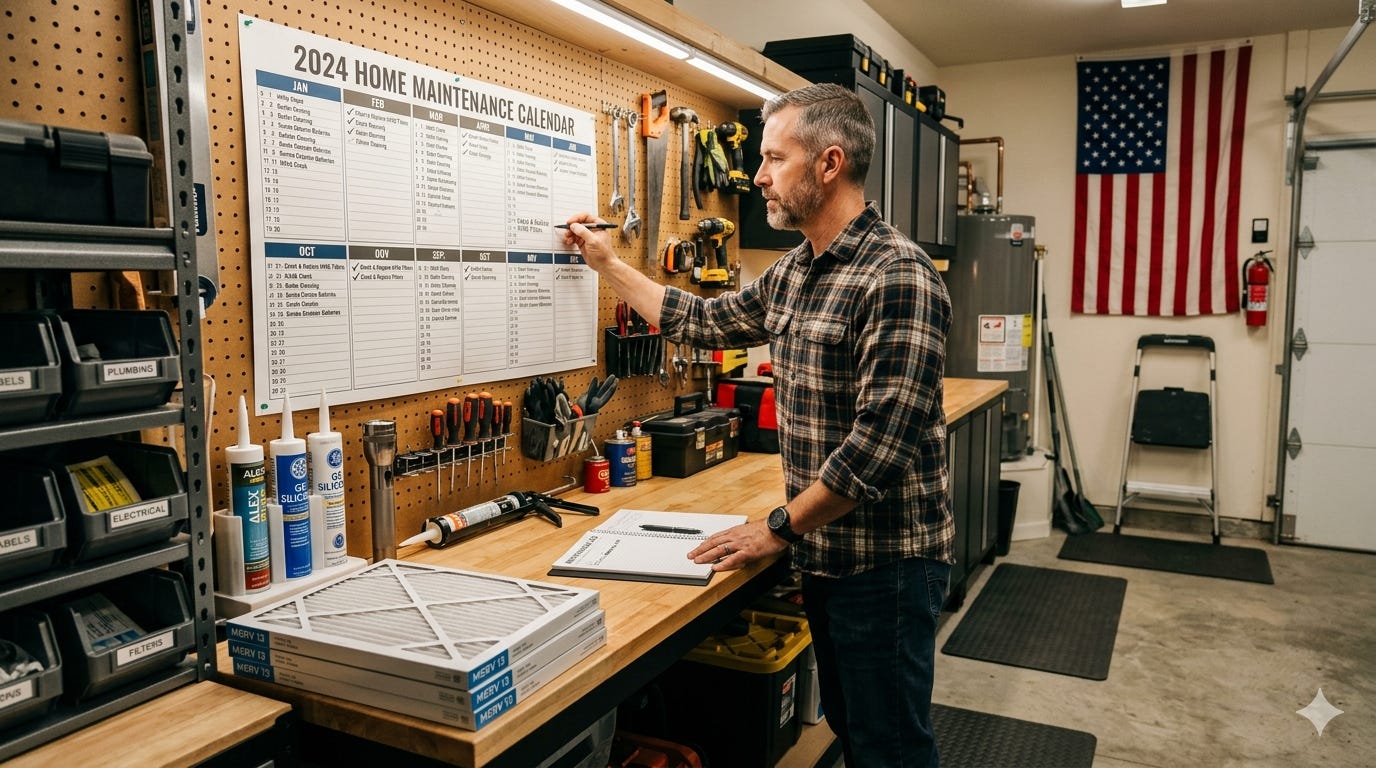
Print this and hang it in your garage or utility room.
January: Test smoke/CO detectors, check pipes in cold areas, run generator test.
February: HVAC filter change, water heater quick drain.
March: Deep HVAC service, gutter cleaning, power wash exterior.
April: Re-caulk windows, trim vegetation, test sprinklers.
May: Appliance coil cleaning, dryer vent deep clean.
June: AC condenser coil cleaning, attic ventilation check.
July: Sump pump test, window AC service.
August: Gutter spot clear, plumbing inspection.
September: Final gutter cleaning, furnace prep, weatherstrip doors/windows.
October: HVAC filter change, drain exterior hoses.
November: Smoke/CO test, water heater check.
December: Roof vent clearing, humidity control, fire extinguisher check.
2. Digital Tracking Spreadsheet Fields (Create in Google Sheets or Excel)
Columns: Month | Task | Due Date | Completed (Y/N) | Date Completed | Time Spent | Estimated Savings | Notes | Photo
Formulas: Auto-sum yearly savings and completion percentage. Add a final row for “Annual Home Health Score” = (tasks completed / total tasks) × 100.
3. Priority Decision Tree (Follow This Order)
Start here every season:
Is house >15 years old? → Check foundation and grading first.
Freeze-thaw climate? → Prioritize pipe insulation and roof ice dam prevention.
Visible leaks or high water bill? → Full plumbing inspection immediately.
Energy bills rising? → HVAC filter, coils, and air sealing.
4. Fully Written Step-by-Step How-To Guides (8 Core Procedures)
Dryer Vent Deep Cleaning
Unplug dryer. 2. Disconnect vent hose from dryer and wall. 3. Use dryer vent brush kit or vacuum with long attachment to clean from both ends. 4. Reconnect securely. Run dryer on air fluff for 5 minutes to clear residue. Do this twice per year.
Tank Water Heater Flush
Turn off power/gas and cold water supply. 2. Attach garden hose to drain valve, run to floor drain. 3. Open T&P valve and drain valve. 4. Flush until water runs clear (30–60 minutes). 5. Close valves, refill, restore power. Check anode rod through top port if accessible — replace if <6 inches left.
GFCI Outlet Testing and Replacement
Press “Test” button — outlet should lose power. Press “Reset.” 2. If it fails, turn off breaker, remove old outlet, disconnect wires, install new GFCI following line/load labels. 3. Restore power and test.
Air Leak Detection and Sealing
Use an incense stick or thermal app on a windy day. Move around windows, doors, outlets, attic hatch. Where smoke blows inward or cold spots appear, apply caulk (exterior) or foam sealant (interior gaps). Pay special attention to baseboards and attic penetrations.
Refrigerator Coil Cleaning
Unplug fridge, pull away from wall, vacuum coils underneath and on back. Use coil brush for fins. Reinstall. Expect 10–15% lower energy use.
Sump Pump Test and Maintenance
Pour 5 gallons of water into pit. Pump should activate and empty pit. Clean debris from float switch. Replace pump every 7–10 years.
Roof Vent and Flashing Inspection
From attic or roof edge, check that all plumbing vents and chimneys have intact flashing and sealant. Re-apply roof cement where cracked.
Electrical Panel Thermal Scan
With panel open (breaker off for safety), use inexpensive infrared thermometer to scan breakers and wires. Any reading 20°F+ hotter than surrounding area needs immediate professional attention.
5. 2026 Parts & Tool Master List
HVAC filters: 20x25x1 pleated MERV 8 (pack of 6 ≈ $45)
Water heater anode rod: Magnesium 3/4” NPT (≈ $25)
Caulk: GE Silicone II or DAP Alex Plus (6 tubes ≈ $35)
Smoke/CO detectors: First Alert 2-in-1 (each ≈ $35)
Pipe insulation: 1/2” foam sleeves (25 ft ≈ $18)
Dryer vent brush kit: $22 on Amazon or hardware store
6. 60-Minute Emergency Home Repair Playbook
Burst Pipe: Shut main water valve (usually near water heater or street side), open faucets to drain lines, call plumber only after containing water.
Roof Leak: Place buckets, move furniture, cover with tarp from outside if safe.
Furnace Failure: Check filter, reset breaker/thermostat, verify gas supply.
Power Outage: Use generator safely outside, carbon monoxide free.
Include a hand-drawn map of your shut-off valves taped inside your electrical panel.
7. Lifetime Savings Projection (Fill in Your Numbers)
Year 1: $2,800 avoided
Year 3: $9,500 cumulative
Year 5: $18,000–$27,000 cumulative (based on national averages for consistent users)
Document every completed task — this record increases resale value by thousands when selling.
8. Video Timestamp Companion
Dryer vent cleaning: Search “ChrisFix dryer vent” — watch 4:15 to 9:30.
Water heater flush: “This Old House water heater maintenance” — minutes 3:20–11:45.
Air sealing: “Home Depot energy audit” — full 12-minute video.
Use these materials exactly as written. You now have the complete operating system in hand. Implement it and watch your home become one of the most reliable and cost-efficient on the block.
Stay capable,
Isaac Abraham
The Self-Reliant American